Hotel or apartment in Skellefteå? The math beyond seven nights
For bookers comparing options for stays of one week, one month or longer — and who want to count the whole cost, not just the nightly rate.
8 min readUpdated Läs på svenska
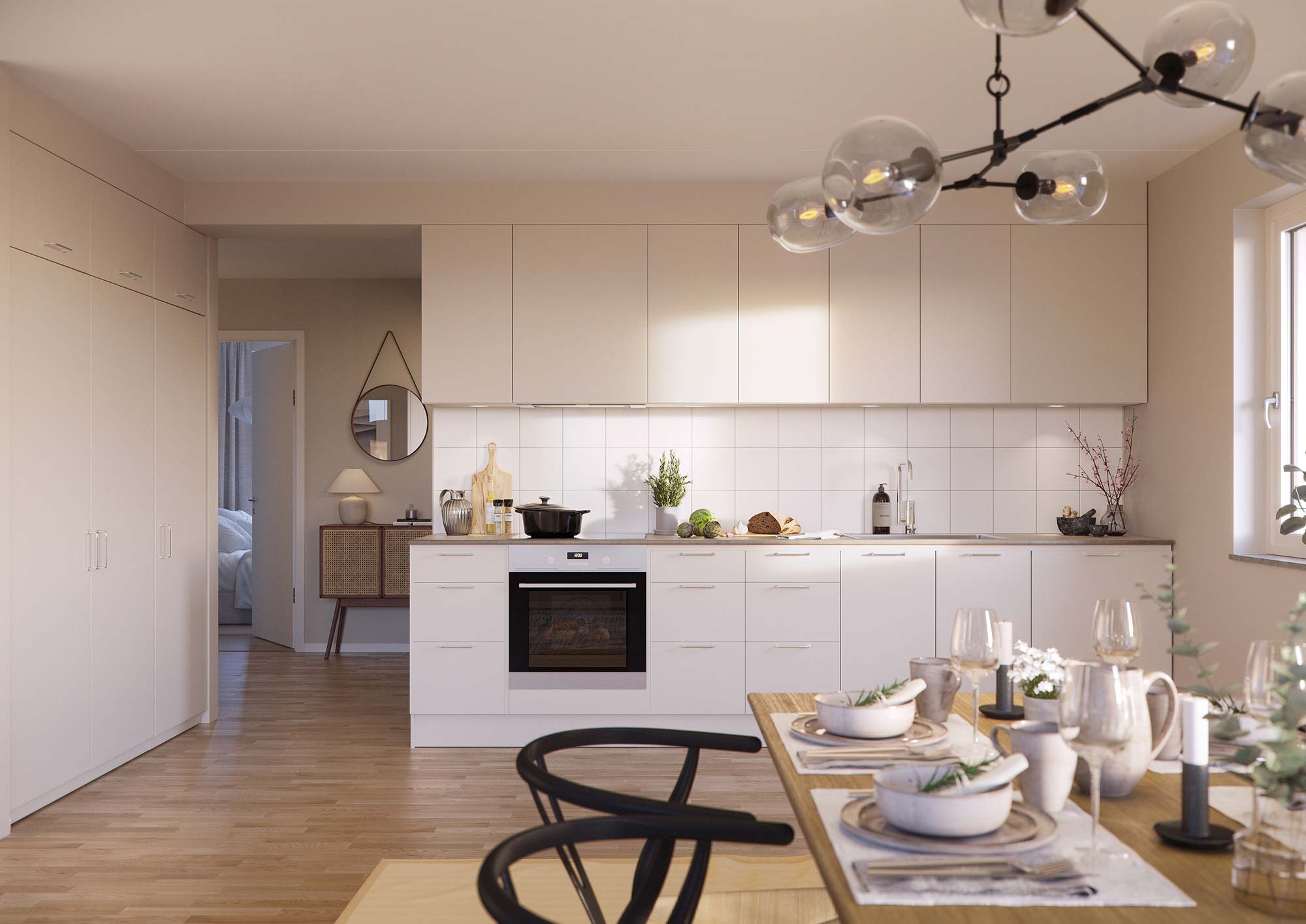
Under seven nights the hotel is usually the right call in Skellefteå — simple, flexible and with breakfast included. After seven nights the math turns: a corporate apartment with an all-inclusive monthly price, a full kitchen, its own washing machine and an agreement in the company's name becomes cheaper per night, better for the guest and simpler for finance. This guide goes through exactly where the turning points sit — and where the hotel still wins.
An HR coordinator compares two quotes on a Wednesday: three specialists are going to Skellefteå for five weeks. The hotel looks cheapest on paper — until she adds thirty-five dinners out per person, laundry without a washing machine, parking per day, and the fact that the team ends up on three different floors. The question is not what does the night cost — the question is what does the stay cost. Honestly: we run corporate apartments, but we also rebook guests into hotels when the stay is too short for our model. The calculation below is the one we use ourselves.
Key facts
- Under 7 nights: choose the hotel. Our minimum booking is 7 nights — shorter than that and the hotel is better value.
- 14–90 nights: home turf for the corporate apartment. Progressive pricing makes longer stays cheaper per night.
- Hidden hotel costs over a month: eating out, laundry, parking, and a room priced per night even when nothing changes.
- The apartment's hidden win: a kitchen, in-unit laundry, a workspace, and the whole team in the same building.
- An exact comparison for your dates: a quote within 55 minutes on weekdays.
When the hotel is the right call
Let's start where other comparisons cheat: the hotel sometimes wins. For one to five nights, the hotel in Skellefteå is usually both the simplest and the cheapest option in total. No booking threshold, breakfast included, cancellation until the last minute, and the city's hotels keep a good standard. If your salesperson is here Tuesday to Thursday: book the hotel. The hotel also wins when the plan is entirely unclear — under 48 hours' notice with an unknown length — and when the guest explicitly wants a reception, a restaurant and service in the building every day. Our model starts at seven nights, and that is no coincidence: that is roughly where the total math turns.
The math: what hotel nights actually cost over time
The nightly rate is the only hotel cost visible in the quote. Over a month, four items rarely counted come on top: Meals — without a kitchen the guest eats out or orders room service; thirty dinners and fifteen lunches per person per month is a significant item, and it never shows up in the accommodation quote, only in the expense reports afterwards. Laundry — hotel laundry is priced per garment, or the guest spends their free time at a laundromat; an apartment with its own washing machine zeroes the item. Parking — per day at the hotel, often as an add-on. A nightly rate with no time discount — a hotel room costs essentially the same on night thirty as on night one; a corporate apartment is priced progressively.
Add the items up over four to six weeks and the pattern is stable: the hotel's total cost passes the apartment well before the end of the month, even when the hotel's nightly rate looks lower at first glance. Exactly where the lines cross depends on your dates, size and volume — which is why we would rather calculate on your real enquiry than publish a table that is never accurate.
Seven turning points after seven nights
- 1.The kitchen. The biggest of them all. Cooking for yourself changes both the economics and the guest's everyday life.
- 2.The laundry. Your own machine in the apartment. No price list per shirt, no evenings at a laundromat.
- 3.The space. A hotel room is a bed with a desk. An apartment is a living room, a bedroom, a kitchen and a workspace — the guest lives there, rather than staying overnight.
- 4.The quiet to work. Video meetings from a living room with a real workspace and verified WiFi, not from the edge of the bed.
- 5.The invoice. One consolidated monthly invoice to the company with VAT specified — instead of nightly line items, restaurant receipts and expense reports.
- 6.The extension. When the assignment moves two weeks out, you extend in the same apartment. At a hotel it is a new booking at rack rate — if there is a room at all.
- 7.Availability during mobilisations. When a large project kicks off in Skellefteå, the hotels sell out first. A block of booked apartments is unaffected by trade-fair weeks and mobilisation peaks.
The team: hotel rooms on different floors, or apartments in the same building?
For a lone traveller the choice is a calculation. For a team it is also logistics and culture. Six technicians in a hotel becomes six rooms scattered across different floors, six breakfast queues and zero shared spaces beyond the lobby. The same team in three shared apartments in one building gets shared kitchens, evenings together and a daily rhythm that holds over months — it shows in both wellbeing and performance.
At Karlavagnen entire teams can be placed in the same building: 17 newly built apartments, 2–4 rooms, with a shared rooftop terrace and courtyard. Rotations are handled inside the block — when technicians are swapped out the apartments keep running, and new names are added to the agreement.
How to compare for yourself — a checklist before booking
- 1.Total cost per person per month — nightly/monthly price + meals + laundry + parking, not just the accommodation line.
- 2.What is included in the price — electricity, WiFi, cleaning, VAT: all specified in writing.
- 3.Invoicing flow — one monthly invoice to the company, or receipts and expense claims?
- 4.Extension terms — the same home, guaranteed, until which date?
- 5.Team logistics — can everyone stay in the same building, and are there shared spaces?
If one option answers worse on three of the five lines, you already know how the math ends.
Frequently asked questions

Joakim Thörn
Founder of Guestly Homes. Runs serviced corporate housing in Luleå, Piteå, Boden and Skellefteå — and writes about the housing question from real bookings.
LinkedInRead next
- Guide · Corporate housing · SkellefteåCorporate housing in Skellefteå: the complete guide for bookersWhat corporate housing in Skellefteå is, who it suits and what it should include — from one week to several years. Written for the people who place the guests: travel managers, project leads and HR.
- Guide · Market · SkellefteåSkellefteå's second wave: what Lyten and EdgeConneX mean for visiting teamsLyten is restarting the battery gigafactory and EdgeConneX has announced plans for a data center campus of up to 1 GW. What it means for visiting teams — and for everyone booking their housing in Skellefteå.